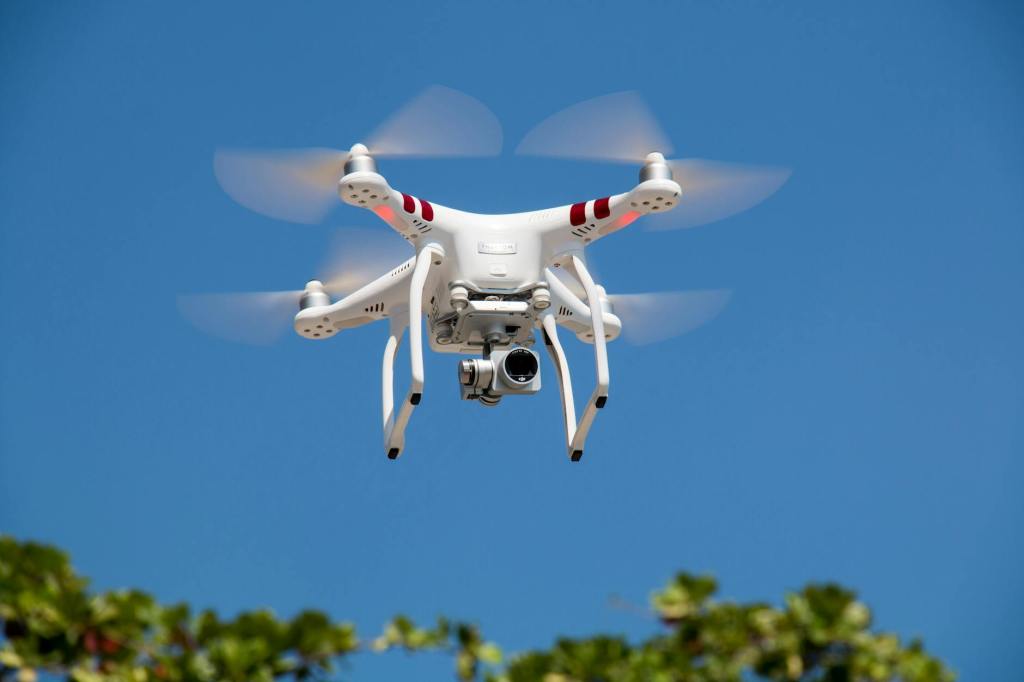
Have you ever wondered how drones — with no wings and no pilot — can hover perfectly still, zip forward, and even flip midair without losing control?
The secret lies in the beautiful combination of aerodynamics, sensors, and control engineering.
In this post, we’ll break down how drones keep their balance, what makes them maneuver so precisely, and the science that lets them defy gravity.
The Basics: How Drones Generate Lift
Most drones you see today are quadcopters, meaning they have four propellers arranged in a square pattern.
Each propeller generates lift — the upward force that counters gravity — by spinning fast and pushing air downward.
To hover, the lift from all four propellers must exactly balance the drone’s weight.
If the motors spin faster, the drone rises; slower, it falls.
Simple in theory — but keeping that balance steady is a complex feat of engineering.
The Trick: Opposite Rotations
Here’s something cool: not all propellers spin in the same direction.
To stay stable, two opposite propellers rotate clockwise, and the other two rotate counterclockwise.
This cancels out the rotational torque that would otherwise spin the drone uncontrollably.
If all propellers turned in one direction, the drone’s body would twist the other way — just like a helicopter without a tail rotor.
By pairing opposite spins, drones achieve torque balance — a key factor in staying steady midair.
Balancing in All Directions: Pitch, Roll, and Yaw
To move in different directions, the drone varies the speed of its propellers:
| Motion Type | How It Works |
|---|---|
| Pitch (forward/backward) | Front propellers slow down, back propellers speed up → drone tilts forward or backward |
| Roll (left/right) | Left propellers slow down, right ones speed up → drone tilts sideways |
| Yaw (turning) | Diagonal propellers change speed slightly to rotate the drone clockwise or counterclockwise |
By constantly adjusting these speeds, the drone can hover, tilt, rotate, or zip in any direction — all while maintaining balance.
The Brain: Sensors and Flight Controllers
Drones don’t rely on human reflexes — they rely on computers.
At the center of every drone is a flight controller, a tiny onboard computer that processes input from multiple sensors, including:
- Gyroscope: measures angular velocity (rotation)
- Accelerometer: detects acceleration and tilt
- Barometer: measures air pressure to estimate altitude
- GPS: tracks position and movement outdoors
These sensors feed data into algorithms that make real-time adjustments to each motor — sometimes hundreds of times per second — to keep the drone perfectly level.
In other words, drones are constantly correcting themselves, even if you can’t see it.
Fighting the Wind
Wind gusts and turbulence constantly push against drones.
To stay stable, the flight controller quickly detects changes in tilt or acceleration and speeds up or slows down the right motors to compensate.
For example:
- A gust pushes the drone forward → the back motors speed up to push it back upright.
- A side wind tips it → the motors on that side increase thrust to re-balance.
It’s like having an invisible pilot making micro-adjustments thousands of times per second.
Power and Efficiency
Stability also depends on motor power and battery performance.
- High-speed brushless motors react faster to controller inputs.
- Lightweight frames reduce inertia, making stabilization quicker.
- Smooth, symmetric propellers reduce vibration and imbalance.
Every detail — from frame symmetry to battery placement — affects how stable and responsive the drone feels in the air.
The Future of Drone Stability
Modern drones use AI and advanced control systems to get even smarter.
Some can now automatically avoid obstacles, hold position indoors without GPS, and even perform smooth cinematic maneuvers autonomously.
Next-gen designs use machine learning to predict wind disturbances before they happen — giving drones near-perfect flight control.
The goal? Drones that fly as smoothly and intuitively as birds.
Conclusion
Drone stability isn’t magic — it’s a masterpiece of mechanical and electronic engineering working together.
By balancing forces, opposing torques, and continuously adjusting motor speeds, drones stay stable, responsive, and controllable in any environment.
The next time you see a drone hovering steadily in midair, remember — behind that smooth flight lies physics, precision, and thousands of tiny calculations per second.




 GearUp Engineering
Leave a comment