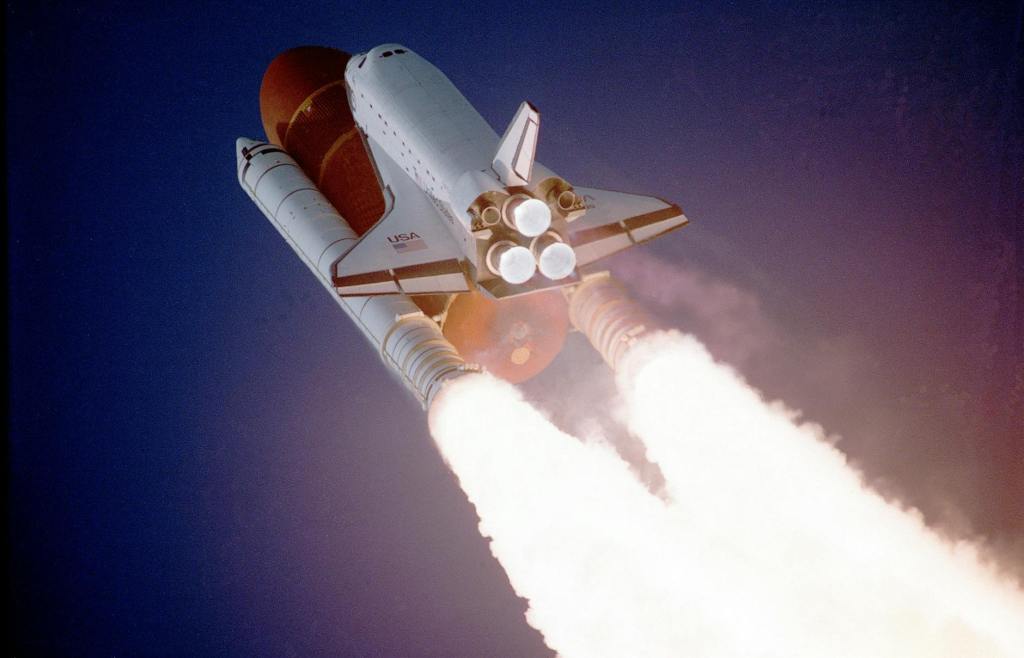
Rockets are some of the most powerful machines ever built — able to lift thousands of tons off the ground and send spacecraft into orbit.
But at their core, rockets work because of one simple law of physics that you probably learned in school:
Every action has an equal and opposite reaction. — Newton’s Third Law of Motion
Let’s explore how this basic principle makes rocket launches possible — without using any complicated math.
The Basic Idea: Pushing to Move
When you walk, you push the ground backward with your feet — and the ground pushes you forward.
A rocket works the same way, but instead of pushing against the ground, it pushes against its own exhaust gases.
The rocket engines expel gas out of the nozzles at high speed, and the reaction pushes the rocket in the opposite direction — upward.
The faster and more mass the rocket pushes out, the greater the thrust that propels it forward.
What Is Thrust?
Thrust is the forward (or upward) force produced by a rocket engine.
Here’s the process in simple terms:
- Fuel (like liquid hydrogen or kerosene) burns with an oxidizer (like oxygen).
- The reaction creates hot, high-pressure gases.
- These gases escape through a nozzle, accelerating downward at incredible speeds.
- The rocket is pushed upward in response — that’s thrust!
So, in short:
Rocket thrust = Hot gases pushed down → Rocket moves up
Escaping Earth’s Gravity
Earth’s gravity constantly pulls everything downward, so rockets need a huge amount of thrust to overcome it.
That’s why launch rockets are so powerful — they must produce more upward force (thrust) than the downward pull (weight).
Once the thrust exceeds the rocket’s weight, the rocket starts to lift off.
As it burns fuel and becomes lighter, it accelerates faster.
Fun fact: A rocket like the SpaceX Falcon 9 produces about 7,600 kN (kilonewtons) of thrust at liftoff — that’s enough to lift more than 500 elephants into the sky!
Action and Reaction in Everyday Life
You can see the same principle in simple experiments:
- Balloon rocket: Blow up a balloon and release it — the air rushing out pushes the balloon in the opposite direction.
- Garden hose kickback: When you turn on a hose at full blast, it pushes backward slightly — that’s reaction force.
- Fire extinguisher on a cart: If you spray it, you’ll roll backward — just like a mini astronaut!
All of these are examples of Newton’s Third Law in action — the foundation of rocket propulsion.
The Role of the Rocket Nozzle
The nozzle is one of the most critical parts of a rocket engine.
It’s designed to:
- Convert heat energy into motion (kinetic energy)
- Direct gas flow efficiently
- Maximize thrust by speeding up the exhaust gases
The nozzle’s shape — narrow in the middle and wide at the end (called a de Laval nozzle) — ensures the gases expand smoothly and accelerate to supersonic speeds before leaving the rocket.
Even though the rocket works in space (where there’s no air to push against), it still generates thrust because it’s pushing on its own exhaust gases.
Why Rockets Work in Space
A common question:
“How can rockets move in space if there’s nothing to push against?”
The answer: they don’t need air!
Rockets push against their own exhaust, not the air around them.
Because of Newton’s Third Law, as long as a rocket ejects mass in one direction, it will move in the opposite direction — even in a vacuum.
That’s why rockets can maneuver in orbit, on the Moon, or even in deep space.
Real-World Rocket Examples
- SpaceX Falcon 9: Uses liquid oxygen and rocket-grade kerosene (RP-1). Its engines generate enough thrust to reach orbit and then safely land back on Earth.
- NASA’s SLS (Space Launch System): Designed for deep space missions, producing over 8.8 million pounds of thrust.
- V-2 Rocket: The first long-range rocket (WWII era) and the foundation for modern rocketry.
Each design uses the same principle — expel gas fast enough, and you’ll move in the opposite direction.
Beyond Earth: The Future of Rocket Propulsion
Modern engineers are working on new types of propulsion that push the limits of physics:
- Ion thrusters: eject charged particles for long, efficient space travel.
- Plasma engines: use magnetic fields to accelerate plasma for deep-space missions.
- Solar sails: use the pressure of sunlight itself to glide through space — no fuel required!
The dream of exploring the stars is powered by one idea — that motion comes from reaction.
Conclusion
Rocket propulsion isn’t just about power — it’s about precision physics.
By pushing gases downward at high speed, rockets move upward with incredible force.
From balloon rockets in classrooms to real rockets reaching Mars, the principle is the same:
Push something back hard enough, and you’ll move forward.
Mechanical and aerospace engineers continue to refine this age-old law into cutting-edge technology — proving that even the simplest physics can take humanity to the stars.



 GearUp Engineering
Leave a comment