Before engines, circuits, and computers — there were simple machines.
These are the basic building blocks of all mechanical systems, created thousands of years ago to make work easier.
From lifting pyramids to driving modern cranes, simple machines transformed how humans built, moved, and created.
Let’s look at the Top 5 simple machines that changed history — and how they still shape the technology we use today.
1. The Lever — Power Through Balance
Invented: Over 5,000 years ago
Inventor: Credited to Archimedes (Greek mathematician)
The lever is one of the oldest and most powerful tools ever invented.
It works by rotating around a fixed point called a fulcrum — allowing a small effort to lift a much heavier load.
Examples in history:
- Ancient Egyptians used levers to lift giant stone blocks.
- Catapults and see-saws use the same principle.
- Modern cranes, car jacks, and crowbars are all advanced levers.
Archimedes once said, “Give me a place to stand, and I shall move the Earth.”
That’s the power of mechanical advantage.
2. The Wheel and Axle — The Foundation of Motion
Invented: Around 3500 BCE in Mesopotamia
The wheel and axle is simple: a wheel (large circle) attached to a smaller axle (shaft). When one turns, the other turns — reducing friction and multiplying motion.
Examples in history:
- The first potter’s wheels made mass production possible.
- The invention of the wheel led to transportation — carts, chariots, and eventually cars.
- Modern machines — from gears to turbines — rely on this same principle.
Without the wheel, there would be no cars, engines, or even modern factories.
3. The Inclined Plane — Lifting Made Easier
Invented: Prehistoric times (no known inventor)
An inclined plane is simply a ramp — a flat surface set at an angle.
Instead of lifting an object straight up, you slide it upward, spreading the effort over a longer distance.
Examples in history:
- Ancient builders used ramps to move heavy stones for the pyramids.
- Wheelchair ramps and slides are modern inclined planes.
- Conveyor belts and escalators are advanced forms that combine multiple planes in motion.
The inclined plane taught humanity that distance could trade off with force — one of the first engineering trade-offs in history.
4. The Screw — The Twisted Plane
Invented: Around 200 BCE (credited to Archimedes)
A screw is just an inclined plane wrapped around a cylinder.
Turning it converts rotational motion into linear force — ideal for lifting, fastening, and compressing.
Examples in history:
- The Archimedean screw lifted water for irrigation.
- Screws later revolutionized construction and manufacturing.
- Today’s bolts, bottle caps, and even airplane engines use threaded systems.
Every twist of a screw is a tiny example of physics turning rotation into power.
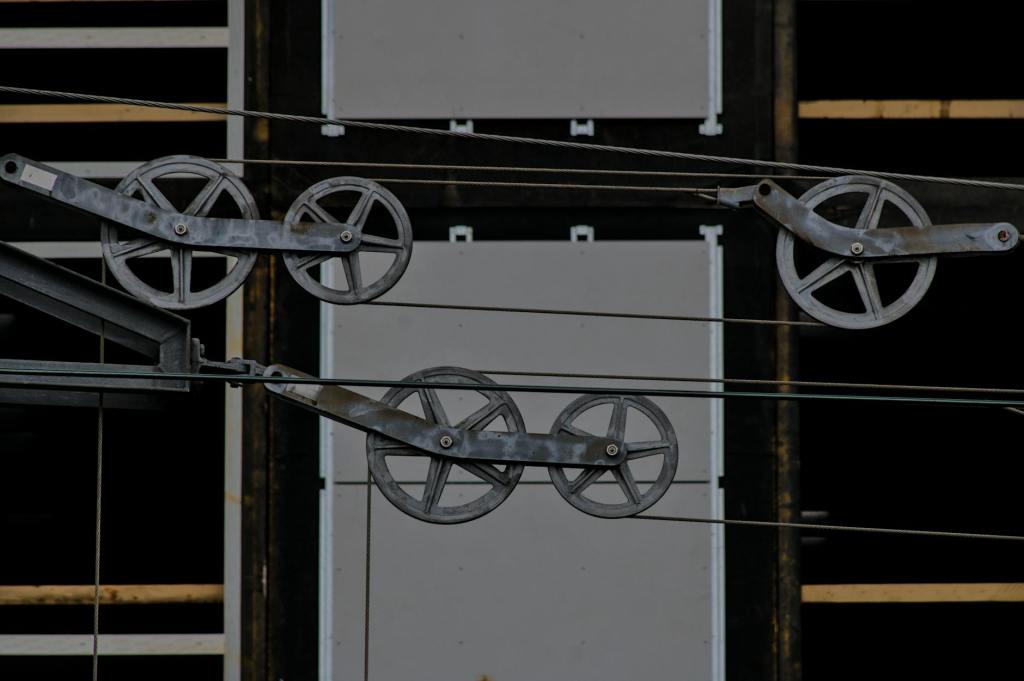
5. The Pulley — Lifting Heavy Loads with Ease
Invented: Around 250 BCE (used in Ancient Greece and Egypt)
A pulley uses a wheel and rope to lift objects more easily.
When multiple pulleys are combined into a block and tackle, they dramatically reduce the effort needed to lift heavy weights.
Examples in history:
- Ancient builders used pulleys to raise massive stones and columns.
- Sailors used them to control sails on ships.
- Today, cranes, elevators, and gym machines rely on pulleys for smooth, efficient motion.
Pulleys made vertical motion practical — from the first temples to modern skyscrapers.
Bonus: The Wedge
A wedge is a moving inclined plane used to split or cut materials.
Knives, axes, scissors, and even airplane wings use wedge-like shapes to divide or push through matter.
Without wedges, cutting and shaping the world would be nearly impossible.
Why These Machines Still Matter
Even in an age of robotics and automation, every modern machine is built from these six simple principles.
| Simple Machine | Modern Use |
|---|---|
| Lever | Car jack, pliers, seesaw |
| Wheel & Axle | Cars, turbines, gears |
| Inclined Plane | Ramps, slides, escalators |
| Screw | Bolts, compressors, bottle caps |
| Pulley | Cranes, elevators, window blinds |
| Wedge | Knives, drills, blades |
From the pyramids to space shuttles, these machines remind us that innovation begins with simplicity — and that mechanical advantage is timeless.
Conclusion
The story of engineering begins not with electricity or software, but with simple physics.
The same principles that helped ancient builders move stones are what let us build engines, rockets, and robots today.
Simple machines may be ancient — but their impact on human progress will never grow old.






 GearUp Engineering
Leave a comment