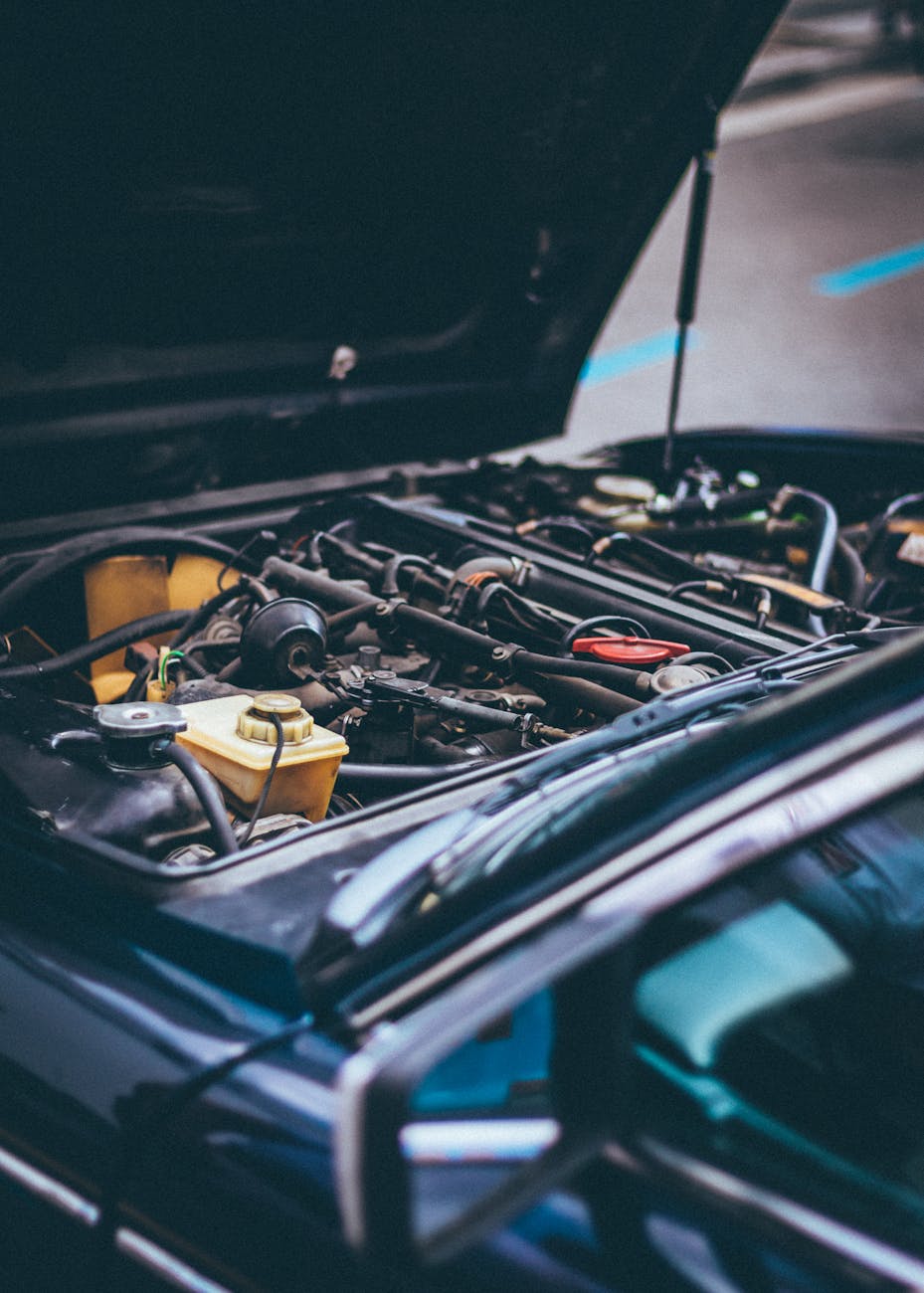
Every time you press the accelerator, your car turns a small burst of fuel into enough energy to move over a ton of metal — smoothly and efficiently.
But how exactly does that happen?
How does gasoline or diesel turn into the spinning motion that drives the wheels?
Let’s take a simple look under the hood and see how chemical energy becomes mechanical motion.
Step 1: Fuel Contains Stored Energy
Car fuel — whether petrol, diesel, or ethanol — is full of chemical potential energy.
When it burns (combines with oxygen), that energy is released as heat and expanding gases.
This controlled burning happens inside the engine’s cylinders, where the fuel-air mixture is ignited thousands of times every minute.
In essence, a car engine is a heat machine — it converts the energy of combustion into motion.
Step 2: The Combustion (Power) Cycle
Most cars use a four-stroke internal combustion engine.
Each cylinder goes through four steps, repeating rapidly to keep the engine running:
- Intake stroke: The piston moves down, drawing in a mix of fuel and air.
- Compression stroke: The piston moves up, compressing the mixture for efficient burning.
- Power stroke: A spark ignites the mixture, creating an explosion that pushes the piston down.
- Exhaust stroke: The piston moves up again, expelling burnt gases through the exhaust valve.
This is called the Otto cycle, and it happens dozens of times per second in every cylinder.
Every small explosion creates force that moves the piston — the heart of how fuel becomes motion.
Step 3: From Linear to Rotational Motion
The piston moves up and down — but cars move forward, not vertically.
To solve this, mechanical engineers use a clever linkage called a crankshaft.
The piston connects to the crankshaft through a connecting rod, which converts the piston’s linear motion into rotational motion.
As the crankshaft spins, it delivers rotational energy to the transmission system — the part that decides how much power goes to the wheels.
Step 4: Transmission and Drivetrain
The transmission takes the spinning motion from the crankshaft and controls how much of it reaches the wheels.
- At low speeds, gears provide high torque (more pulling power).
- At high speeds, gears reduce torque but increase rotation speed.
The power then travels through the driveshaft and differential, which split it between the wheels.
This system ensures smooth acceleration and efficient energy use.
Step 5: The Wheels in Motion
Finally, the rotational energy reaches the axles, turning the wheels — and your car begins to move.
At this point, the car’s kinetic energy comes directly from the energy once stored in fuel molecules.
Even the smooth hum of your engine is millions of controlled explosions per minute, perfectly timed to keep motion continuous.
It’s physics in perfect harmony: chemical → thermal → mechanical → motion.
What About Electric Cars?
Electric vehicles don’t burn fuel, but the principle is similar — they just skip the combustion step.
Instead of burning fuel, electric motors convert electrical energy from batteries directly into rotational motion.
This makes them far more efficient — nearly 90% of battery energy becomes motion, compared to only about 30% in combustion engines.
But whether it’s electricity or fuel, the end goal is the same: turn stored energy into motion.
Conclusion
A car is a masterpiece of mechanical engineering — a perfect example of how physics, chemistry, and design work together.
Every time you drive, your engine converts tiny chemical reactions into powerful mechanical motion — smoothly, reliably, and thousands of times per minute.
From fuel to fire, from piston to wheel — every journey starts with a spark.





 GearUp Engineering
Leave a comment