
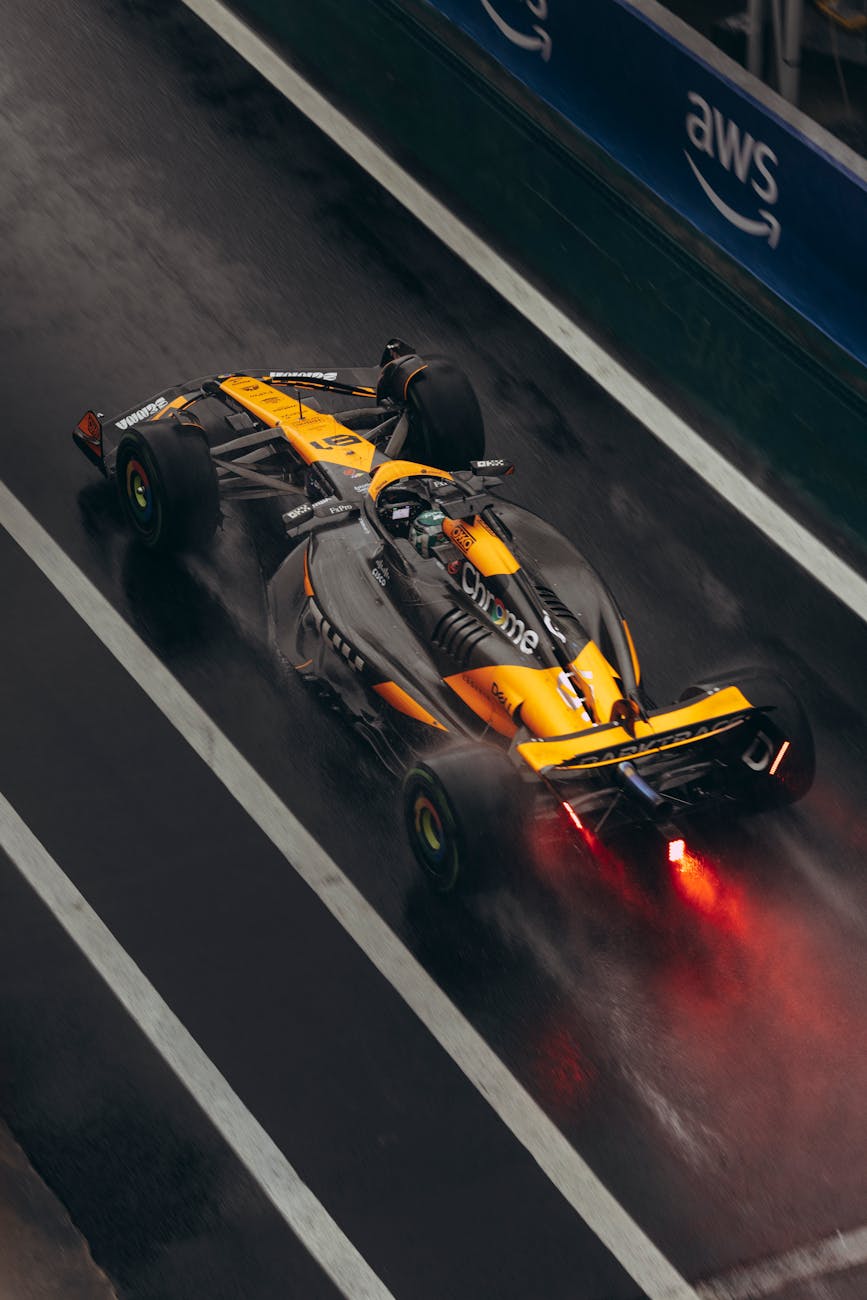
When we think of Formula 1 cars, the first thing that comes to mind is speed — these machines can reach over 350 km/h, slicing through air like bullets. But here’s the fun twist: the same science that keeps airplanes flying high also helps F1 cars stick firmly to the ground. Surprising, right?
The Lift that Keeps Planes Flying
Airplane wings are designed to generate lift. Their shape — called an airfoil — makes air move faster over the top and slower below. This difference in airspeed creates a pressure difference (thanks to Bernoulli’s Principle), lifting the plane into the sky. The faster the plane moves, the greater the lift.
In simple words, airplane wings use aerodynamics to fight gravity.
The Inverted Idea: From Lift to Downforce
Now, F1 engineers looked at that concept and said:
“What if we flipped it upside down?”
That’s how the spoiler or rear wing was born. Instead of lifting the car, an F1 wing is designed to push it downward. This force is called downforce — the exact opposite of lift.
When the car is pushed down, the tires grip the track better, allowing the driver to corner faster without skidding. At top speeds, an F1 car can generate so much downforce that it could theoretically drive upside down in a tunnel (if only someone tried!).
The Science Behind It
Just like airplane wings, F1 spoilers use the airfoil shape, but inverted. The air moves faster underneath the wing and slower above, creating higher pressure on top and pushing the car downward.
Here’s the basic aerodynamic principle:
- Plane wings: Low pressure on top → Lift upward
- F1 wings: Low pressure below → Downforce downward
Both rely on controlling airflow — that invisible yet powerful element every engineer obsesses over.
Why It Matters
Downforce doesn’t just make cars stick to the road — it improves cornering, stability, and braking. That’s why you’ll notice complex wing shapes, side pods, and diffusers on modern F1 cars. Each is carefully designed using wind tunnels and Computational Fluid Dynamics (CFD) to balance downforce and drag.
Too much downforce slows the car on straights, while too little makes it unstable in corners. Engineers are always chasing that perfect aerodynamic balance, inspired by the same physics that let planes fly.
Final Thoughts
It’s fascinating how two completely opposite goals — flying and sticking to the ground — are achieved using the same aerodynamic principles. Airplane wings and F1 spoilers are like twins with different destinies: one defies gravity, the other uses it.
That’s the beauty of engineering — ideas don’t just stay in one field; they evolve, transform, and sometimes even flip upside down to create something extraordinary.


 GearUp Engineering
Leave a comment